BRRRR Calculator
Use the free BRRRR Calculator to estimate cash flow, DSCR, refinance proceeds, and total project costs for your next Buy Rehab Rent Refinance Repeat deal.
nmin readReleased on:August 13, 2026Last updated on:September 17, 2026
Understanding The BRRRR Calculator
The main purpose of using this BRRRR Calculator is to make sure that before you buy and renovate a distressed property, the financials of the project allow you to:
- Refinance the entire cost of the purchase and rehab into a low rate DSCR loan upon project completion.
- To make sure that the property has a debt service coverage ratio (DSCR) greater than 1.0 (i.e. the property is cash flowing upon refinancing).
The calculations are broken down into two sections: Purchase + Rehab + Rent + Refinance.
How to Use the BRRRR Calculator
The calculator runs two sequential analyses: the acquisition and rehab phase, then the refinance. Fill in each section in order. Results update in real time as inputs change.
Step 1: Buy — Acquisition
Three inputs define the cost basis at closing.
- Purchase Price: The contract price paid for the property.
- Down Payment: The cash brought to closing. The short-term loan covers the remainder of the purchase price plus the full rehab budget.
- Closing Costs: All acquisition closing costs as a percentage of the purchase price — title fees, transfer taxes, and recording fees.
Step 2: Rehab — Renovation and Hard Money Financing
These inputs determine the total interest carry and holding cost during the renovation project.
- Rehab Budget: Total renovation cost, including materials and labor.
- Project Timeline: Months from acquisition closing to refinance closing. Each additional month adds interest carry and holding costs to the total project cost.
- Hard Money Loan Rate: Annual rate on hard money or rehab loan. Interest on the acquisition portion accrues from day one. Rehab draws accrue on a non-Dutch basis, meaning interest accrues only on funds actually disbursed, not on the full committed rehab amount.
- Origination Fee: One-time lender fee at acquisition closing, as a percentage of the hard money loan.
- Monthly Carrying Costs: Insurance, property taxes, and any other recurring costs during the rehab period.
Step 3: Rent — Income and PITIA
These inputs feed directly into the DSCR calculation on the refinance loan.
- Monthly Gross Rent: Full monthly rent at 100% occupancy after renovations are complete. Experienced investors typically apply a 5% to 8% vacancy factor before entering this figure.
- Vacancy Rate: Expected vacancy as a percentage of the year. The calculator discounts gross rent by this rate before computing DSCR.
- Monthly PITIA Costs: Insurance, property taxes, and HOA, where applicable, on the stabilized rental. These combine with the refinance P&I to form the DSCR denominator.
Step 4: Refinance — DSCR Loan Terms
These inputs determine how much capital the refinance recovers and whether the loan qualifies.
- After Repair Value (ARV): The appraised market value after renovation. ARV accuracy determines whether the BRRRR cycle closes. The refinance loan is calculated as a percentage of this figure.
- Refinance LTV: The loan-to-value on the DSCR cash-out refinance. Higher LTV extracts more capital but raises monthly debt service and lowers DSCR.
- Refinance Rate: Annual rate on the DSCR refinance loan.
- Origination Fee: One-time lender fee at refinance closing, deducted from net proceeds.
- Payment Type: 30-year fixed builds equity each month. Interest-only carries a lower payment, which directly improves DSCR on the same rent.
Running the BRRRR calculator before approaching a BRRRR lender is the right first step. If the numbers raise questions about project structure, ARV assumptions, or whether the refinance will qualify at the expected LTV, the Ridge Street Capital lending team is available to work through the deal directly.
Purchase and Rehab Calculations For the BRRRR Strategy
The calculations in this section determine the costs associated with buying and rehabbing the property.
Total Project Cost (Purchase + Rehab) = Purchase Price + Rehab Expenses + Monthly Interest Carry + Loan Origination Fees + Monthly Taxes & Insurance + Miscellaneous Closing Costs
As a rule of thumb, the Total Project Cost (Purchase + Rehab) should not exceed 75% of the after-repair value (ARV).
Rent and Refinance Calculations For the BRRRR Strategy
The calculations in this section verify that the project will cash flow upon refinancing and that the refinance loan amount will be greater than the Total Project Cost (Purchase + Rehab).
DSCR = Monthly Rent* / (Monthly Loan Payment + Taxes + Insurance + HOA) *
*Effective rent after vacancy discount: Monthly Rent × (1 − Vacancy Rate)
*HOA if applicable
Net Proceeds = Refinance Loan Amount - Refinance Loan Origination Fees - Total Project Cost (Purchase + Rehab)
To satisfy the BRRRR Strategy, the net proceeds must be greater than 0, and the DSCR must be greater than 1.
Refinance Loan = ARV × Refinance LTV%
This is the maximum capital the refinance can return. If this figure falls below the total project cost, the BRRRR produces a partial recycle — some invested capital remains in the deal.
What Your Results Mean
The results panel updates on every input change. The key outputs to evaluate:
- DSCR Rate: A DSCR of 1.0 or above means the property's rental income covers its monthly debt service, and the refinance qualifies. Ridge Street Capital requires a minimum DSCR of 1.0 at refinance. Deals with a DSCR above 1.20 generally qualify for the best pricing.
- Net Proceeds: A positive figure means the refinance returned more than the total project cost — full capital recycle. A negative figure means that the dollar amount remains deployed in the property.
- Capital Recycled: Refinance proceeds as a percentage of total project cost. At 100% or above, all invested capital has been returned to deploy on the next deal.
- BRRRR Verdict: A summary output (Ideal, Strong, Partial Recycle, or Doesn't Qualify) is based on whether the deal recycles capital, generates cash flow, and clears the DSCR threshold.
- Break-Even Rent: The minimum monthly gross rent at which DSCR reaches exactly 1.0, adjusted for vacancy. Gross rent below this figure means the property does not qualify for the refinance at current terms.
- Cash-on-Cash Return: Annual cash flow as a percentage of capital remaining in the deal. Displays as ∞ when the BRRRR fully recycles capital, meaning that the investor earns a return on zero remaining equity.
BRRRR Financing
The are two 'BRRRR loans' you will need to secure in order to execute the BRRRR investment strategy:
1. Hard Money Loan: A short-term (12-month) interest-only loan used to acquire and renovate properties in distressed condition. A hard money loan consists of an initial advance paid at closing and a rehab holdback component paid out as rehab is completed. Ridge Street Capital's hard money loans cover 75% to 90% of the purchase price with a 100% rehab holdback. As of Q1 2026, interest rates on hard money loans are between 10.5%-11.5%, depending on the borrower’s experience and the project LTVs.
For full hard money loan terms, see Ridge Street Capital's fix and flip loan page. Investors can get pre-approved for a project or apply for financing on an active deal.
2. DSCR Refinance Loan: The DSCR loan bases the refinance loan amount on the monthly cash flow of the property. Upon refinancing, the property must have a DSCR greater than 1.0. Run the BRRRR Calculator above to confirm the expected DSCR before beginning the project.
BRRRR Case Study
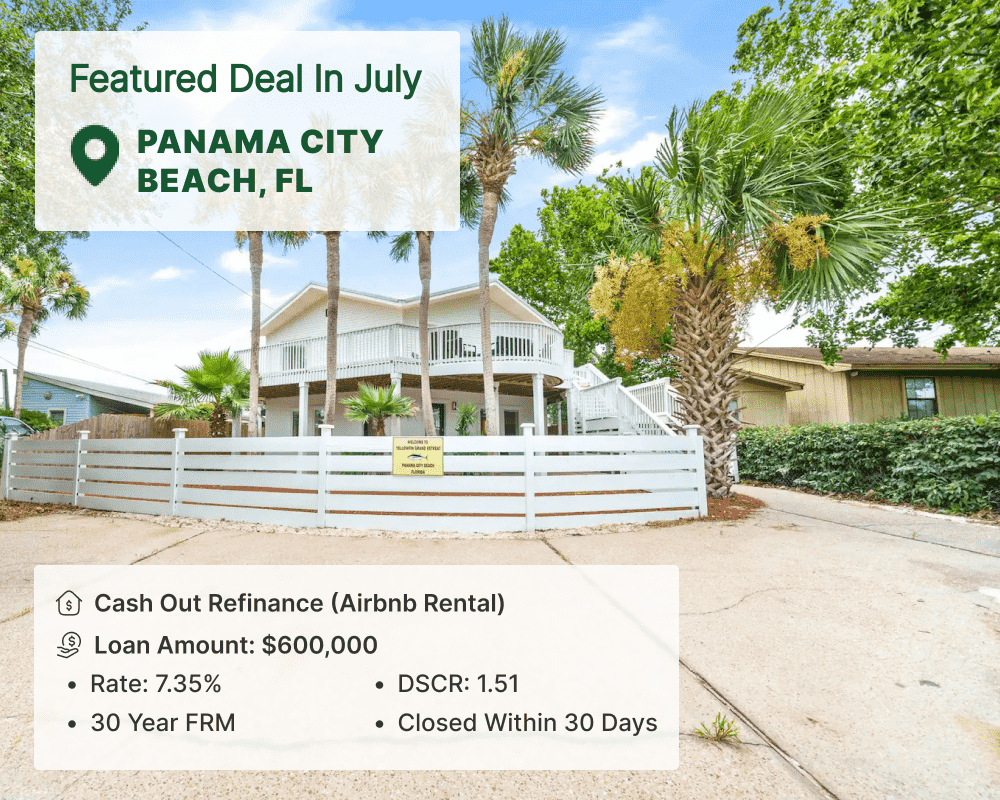
Ridge Street Capital works with BRRRR Real Estate Investors across 35 States every day. Below is a case study of a BRRRR Real Estate Investment that one of our clients made in July of 2024 on a project that we financed. The case study goes through the full deal scenario, the loan metrics, and specifics on how we evaluated the project.
View Full BRRRR Strategy Case Study
Best States for the BRRRR Strategy
The BRRRR strategy works best in states where the rent-to-property value ratio is high. This means investors can acquire properties at a relatively low cost while generating strong rental income - key factors in maximizing cash flow and refinancing potential.
States with affordable housing markets and strong long term rental demand, such as Ohio, Indiana, Pennsylvania, and Maryland, are often prime BRRRR locations.
However, higher-cost markets can also work for BRRRR—especially when utilizing short-term rentals. In states like Florida, Tennessee, North Carolina, and Colorado, Airbnb and vacation rental markets allow investors to generate significantly higher rental income than traditional long-term leases. Cities with strong tourism, such as Nashville or Denver, can provide exceptional returns, making them viable for BRRRR.
Ultimately, the best states for BRRRR depend on the balance between acquisition costs, rental income, and financing options.
If you’re considering becoming a long distance landlord for a rental property, you might also be asking, “What do I need to know before managing a rental property out of state?” Here’s an article we wrote with Redfin.com on what to know before taking the plunge into long-distance real estate investments: Managing a Rental Property Out of State.
Finance Your BRRRR with Ridge Street Capital
Ridge Street Capital is a private lender providing BRRRR loans across 36 states. Apply, get pre-approved, or schedule a call to learn more.
BRRRR Method Calculator FAQs
How much cash do I need to execute BRRRR?
The cash requirement at acquisition closing is the down payment plus origination fees, closing costs, and any carrying costs not covered by the loan. With 80% to 90% acquisition financing and 100% rehab financing from a hard money lender, out-of-pocket capital at closing is typically 10% to 20% of the purchase price plus fees. The goal of the BRRRR cycle is to recover that initial cash through the refinance. When net proceeds exceed total project cost, the investor recycles capital to fund the next acquisition.
What is the 70% rule in the BRRRR strategy?
The 70% rule sets a maximum total project cost threshold: total acquisition and rehab costs should not exceed 70% to 75% of the after-repair value. At that level, the refinance loan, typically capped at 75% to 80% of ARV, is likely to cover the full project cost and return the investor's capital. When the total project cost exceeds 75% of ARV, the refinance produces a partial recycle or no recycle at the standard LTV limits. The calculator's total project cost output flags this directly.
How does the refinance step affect returns?
The refinance converts a short-term, high-rate hard money loan into long-term DSCR financing at a lower rate and longer amortization. Monthly carrying costs drop, cash flow improves, and the capital deployed in the deal is returned to the investor in the form of net proceeds. When the refinance fully recycles capital, the investor holds a cash-flowing rental property with no remaining equity tied up. The cash-on-cash return becomes a function of cash flow on a zero-equity position. That dynamic is what makes a successful BRRRR fundamentally different from a standard buy-and-hold acquisition.

Zach Cohen is the Managing Partner of Ridge Street Capital, a direct private lender providing hard money and DSCR loans to real estate investors across 36 states. Under his leadership, the firm has funded nearly $100 million in investment property loans. He regularly works with real estate investors on rental property acquisitions, refinances, and fix-and-flip projects across the country.
Fix and Flip Loans
Funding For Purchase + Rehab
- $50,000 up to $3,000,000
- Interest Rate 10.5%-11.5%
- Origination Fee From 1.5%
- Up to 90% of Purchase and 100% of Rehab

DSCR Loans For Long Term Rentals
Perfect for first-time investors or experienced investors scaling their rental portfolio.
- Up to $2,000,000
- Interest Rates from 6.0%
- Origination Fee From 0%
- Up to 80% of LTV

DSCR Loans For Short Term Rentals
Designed for investors pursuing higher rents with a short term rental strategy.
- Up to $2,000,000
- Interest Rates from 6.25%
- Origination Fee From 0%
- Up to 80% LTV
Ready to Get Started?
.svg)