Fix and Flip Loans for Beginners: How to Finance Your First Flip
Learn what lenders check on a first flip, including credit score, cash to close, leverage, rehab scope, and how beginners qualify without experience.
nmin readReleased on:November 10, 2024Last updated on:October 14, 2026


Overview:
- A first-time investor can get a fix and flip loan. Hard money lenders underwrite the deal rather than the borrower’s history, so a beginner with a 660 credit score and cash to close qualifies. Ridge Street approves first-timers for projects in their home state.
- A first-time investor’s credit score sets how much the lender advances. At Ridge Street, 660 buys 75% of the purchase price, 720 buys 80%, and 740 buys up to 90% loan-to-cost. Every tier funds 100% of the renovation budget.
- Common mistakes for first-time flippers include underestimating renovation costs, overestimating after-repair value, skipping the inspection, choosing a slow lender, picking too heavy a first project, and leaving no second exit if the property does not sell.
A version of this conversation happens every week. An investor calls to say they are starting a house flipping business and want a lender to partner with. We tell them we are glad to help and ask to walk through a deal they are looking at. Then comes the answer: they have not started looking at properties yet, because they want the funding sorted first.
That is the biggest misconception among new flippers. The logic seems sound, since nobody can buy a house without money.
The truth is, money is made in house flipping when you enter at the right price, with the right scope of work, and an achievable sale price.
Sourcing a deal that clears all three is the hard part of flipping. The lending comes second.
That does not mean financing takes care of itself.
The number one deal breaker for first-time investors trying to get a fix-and-flip loan is a projected ARV that is not supported by market data. The other two common issues are not enough cash to close and a credit score below the lender’s requirement. Experience is not on that list.
This guide covers how fix and flip loans for beginners actually get approved: what a lender checks when a borrower has no track record, what the credit floor is, where first-time house flippers find that money, and what happens from application through the final draw.
Can Beginners Get Fix and Flip Loans?
Yes. Hard money lenders don't require prior flipping experience. A first-time investor with a 660+ credit score, enough cash to close, and a deal that lands inside 75% of after-repair value can get funded.
Experience affects leverage and pricing. Not whether the borrower can qualify at all.
A fix and flip loan is a short-term bridge loan, usually 6 to 18 months, that funds the purchase and the renovation and gets repaid out of the sale. The fix-and-flip loan guide covers how the structure works in full.
No-Experience House Flipping Loans: What Lenders Check When You Have No Track Record
Hard money underwriting is asset-based. The lender is looking at whether enough spread sits between the all-in cost and the after-repair value for the deal to survive if the project underperforms.
Credit score and cash still get reviewed during underwriting. But mostly to confirm that the borrower can close and carry the project.
Here are the 5 factors that Ridge Street checks:
- After-repair value (ARV). The estimated resale value once the renovation is done. Ridge Street caps the loan at 70% of it on a first flip, a measure called loan-to-after-repair-value.
- Loan-to-cost (LTC). How much of the purchase and rehab the lender will fund. First-time borrowers typically see 80% to 85%, while investors with a track record reach 90%.
- Credit score. 660 is the floor, and the score above it sets how much Ridge Street advances. The next section breaks the tiers down.
- Cash reserves. The down payment plus three to six months of interest payments. Thin reserves are the most common reason a first-time application stalls.
- Rehab size. On the Beginner tier the renovation budget cannot exceed 50% of the purchase price. For example, a $200,000 house supports up to $100,000 of repairs.
Our guide to hard money loan requirements covers the full underwriting bar: credit brackets, reserve requirements, and how ARV and loan-to-cost interact to set the loan amount.
Why First-Time Flippers Are Approved Only in Their Own State
Ridge Street approves first-time investors for projects in the state where they live. The rule is based on project risk, not licensing.
An investor who can drive to the property can walk the job and identify contractor delays or issues early. With distance, it becomes much harder to control day-to-day execution.
Many first-time house flipping projects fail during renovation. Rehab work has a lot of variability: timelines stretch, budgets run over, work quality can fall short, contractors can disappear, and hidden defects can show up. Those problems are harder to manage remotely.
House Flipping Loans For Beginners: What Experience Actually Changes
Some institutional lenders require prior flips before they will fund a deal. Most direct private lenders take a different approach. They adjust the terms instead of declining a newer borrower.
In that situation, experience shows up in three areas:
- Leverage. Investors with completed flips can qualify for higher leverage, particularly on heavier renovations.
- Rate. First-time investors pay a premium, typically 0.25 to 1.0 percentage points.
- Origination fee. Some lenders charge newer borrowers more. Ridge Street does not price origination on experience.
What Credit Score Do You Need for Your First Flip?
Investors searching for fix and flip loans for beginners with bad credit are usually asking one question: is 660 negotiable? It is not.
A 660 FICO score is the floor at Ridge Street, regardless of the investor’s experience. Above 660, credit score affects the loan terms. A higher score can support higher leverage, which means the borrower may need less cash at closing.
Ridge Street funds the full renovation budget in every tier. The purchase advance is what changes.
Let’s look at the Cape Coral case study that is described later in this guide: a $200,900 purchase with a $42,450 rehab budget. The table below shows how the loan terms change across different credit profiles.
A borrower at 740 brings $25,890 less to the table than a borrower at 660 on the identical property. For an investor sitting at 710 with a first deal three months out, that gap is usually worth more than any rate shopping.
That surprises people, because hard money gets described as asset-based lending where only the property matters. The property does set the ceiling. Even so, Lenders read credit as evidence of how the borrower has handled debt in the past. That matters because a fix-and-flip loan has a balloon payment at maturity.
A borrower who has missed payments on smaller obligations presents a different risk when the full loan balance comes due at once.
Investors searching for no-credit-check or no-doc flip loans will find lenders advertising them. In most cases, those programs carry higher rates, lower leverage and shorter terms, and the extra cost runs past whatever the borrower saved by skipping the credit review.
A borrower below 660 has two real paths. The first is to raise the score and come back, which for most people takes months rather than years. The second is to bring in a partner who qualifies and guarantees the loan, which happens often on first deals.
How Much Money Do You Need for Your First Flip?
The down payment is only one line item. The list below shows what a first deal actually costs at closing.
- Down payment. Set by the credit tier above. On a $200,000 purchase, that is $50,000 at 660, $40,000 at 720, and less again at 740.
- Origination fee. Ridge Street charges 2.0% of the loan amount on the Beginner tier. On a $200,000 loan, two points equal $4,000.
- Underwriting fee. $1,250 to $1,995, sometimes called a processing or legal fee, covering the lender's cost of loan origination.
- Closing costs. 2% to 4% of the loan amount for title insurance, builder's risk insurance, state fees and escrow. These are not lender charges.
- Rehab contingency. Budget 10% above the contractor’s quote. A $45,000 renovation should have another $4,500 set aside for conditions nobody found during the walkthrough. This is not a mandatory line item, but it is strongly recommended.
- Interest carry. Ridge Street prices the Beginner tier between 10.75% and 11.5%. Interest is paid monthly while the project is active, so borrowers should budget for three to six months of payments. There are no prepayment penalties on fix and flip loans at Ridge Street.
- Draw fees. $200 to $300 per request. A four-draw project costs $800 to $1,200.
- Selling costs. 5% to 6% of the sale price in commissions and closing costs. On a $325,000 sale, that is $16,000 to $20,000. These costs come out of the sale proceeds, but they should be included in the profit math. Use our Fix and Flip calculator to run your numbers.
On the question of 100% financing, what lenders advertise as 100% almost always refers to the renovation budget rather than the whole project.
The 100% hard money financing guide breaks down what is actually covered and what the borrower still brings.
How First-Time House Flippers Fund a Deal
New flippers usually think the choice is cash or a bank, and neither option works here.
Banks usually will not lend on a property that fails appraisal or condition standards. Paying cash puts the deal out of reach for most investors starting out.
Most first deals are funded from four sources.
- Hard money from a direct lender. The lender funds the purchase and the renovation against after-repair value, closes in days rather than weeks, and asks for no tax returns or w-2.
Fix-and-flip rates usually run from 10% to 13%, which is higher than standard investment property mortgage rates. That is the cost of speed, and the cost of lending on a property a bank will not touch.
- Private money from an individual. An individual lender is a person, often someone the investor already knows, who lends their own capital against the property. Terms are negotiated deal by deal, which cuts both ways.
A friendly rate is possible, but so is a handshake agreement with no clear recourse if the project runs long.
- Home equity. A line of credit or a cash-out refinance on a primary residence or an existing rental turns trapped equity into cash to close. This funds more first deals than anything else, and it puts the investor's own home behind the flip.
- A partner who brings the capital. Plenty of first deals get done with one person sourcing and running the project and another funding it.
In practice, most first deals combine two of them: a hard money loan covering the bulk of the project, and home equity or a partner covering the cash to close.
Fix and Flip Loans For Beginners: A Real First-Time Deal Case Study
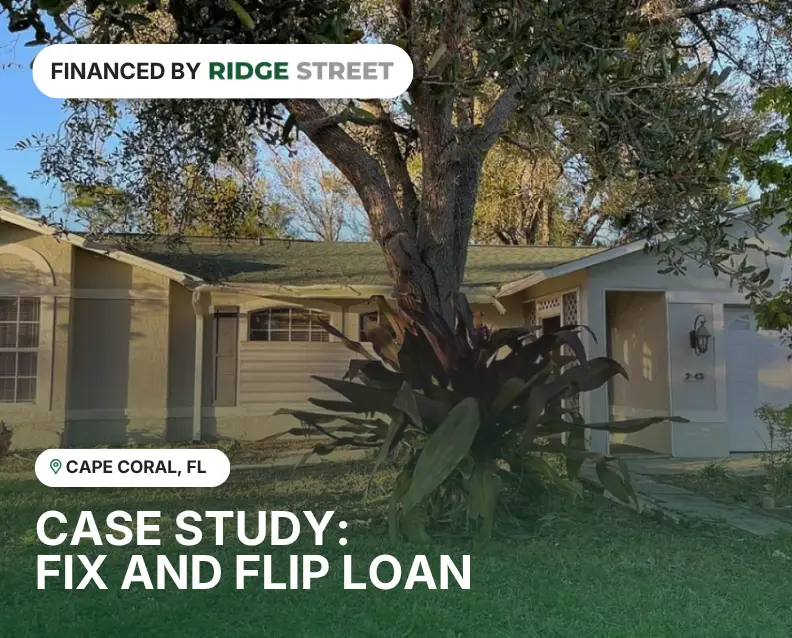
Here's a project we funded for a first-time investor in Cape Coral, Florida. The property was a 3-bedroom, 2-bathroom bank foreclosure listed on the MLS, no wholesale connections required. The house was purchased for $200,900 and required a light cosmetic rehab of $42,450.
The conservatively estimated after-repair value was $325,000, with an exit market rent of $2,400. The project showed a clear path to a profitable exit in both fix & flip and fix & refinance scenarios.
The Numbers
Cash to close was approximately $40,000–$45,000, covering the down payment ($35,075), the unreimbursed portion of the renovation budget ($4,575), and closing costs.
Why It Worked
The renovation was cosmetic: paint, flooring, and a kitchen refresh. Cosmetic rehabs run faster, carry fewer unexpected costs and delays, and keep the contingency intact.
This deal also had a clean fallback. At a $2,400 monthly market rent, the property supported a DSCR loan refinance if the resale stalled. The property was sold, but underwriting a deal with two exits is what separates disciplined investors from those betting on a single outcome.
One practical note: this property went under contract the week before Hurricane Milton hit Florida. Ridge Street verified the condition via photos and closed on schedule. A conventional lender would have required a full re-inspection and likely delayed two to four weeks. Use our Hard money loan calculator to run numbers for your deal.
Before committing capital to a project, it's worth asking is it profitable to flip houses in the current market.
How to Get Your First Fix and Flip Loan, Step by Step
Step 1: Get pre-approved before you find a deal
Pre-approval on a hard money loan does not require a property. An investor without a property under contract can still submit an application and find out whether they qualify as a borrower. That clears the credit question before they need to move quickly on a real deal.
Step 2: Run the numbers before you submit
Investors use the 70% rule to set a ceiling on what to offer.
Maximum offer = (ARV x 0.70) - renovation costs
On a property with a $325,000 after-repair value that needs $40,000 of work, the maximum offer is $187,500. Add the renovation back and the all-in cost is $227,500. The 70% rule guide works through more cases.
Two different 70% figures show up in house flipping, and beginners often mix them up.
The 70% rule is an investor guideline for protecting profit. Ridge Street’s 70% limit is different. It is a loan-to-ARV ceiling, which compares the loan amount to the after-repair value. It does not compare the purchase price to the ARV.
A deal can break the 70% rule and still fit inside the lender’s 70% ARV limit.
The featured case study in Cape Coral project is a good example. The 70% rule would have capped the offer at $185,050, but the investor paid $200,900, or $15,850 above that number. The loan still landed at 62.7% of after-repair value, well inside Ridge Street’s 70% ceiling, and the deal worked.
Treat the 70% rule as a filter for finding deals worth underwriting, not as the lender’s test.
To estimate after-repair value, pull sold comps within half a mile from the past 90 days, matched on square footage and bed and bath count. Use sold prices and ignore active listings, since a listing is just an asking price.
Get two contractor quotes before applying, because lenders size the rehab holdback off a line-item scope of work. Cheap bids tend to turn into missed deadlines and change orders, so look for contractors who work on investment renovations and can point to finished projects. Model your budget conservatively.
Step 3: Request a term sheet
Submit the address, purchase price, renovation budget, after-repair value and entity documents. The lender comes back with loan-to-cost, rate, origination and the draw schedule. Ridge Street returns term sheets within two business hours.
Step 4: Inspection and appraisal
Once the property is under contract, it’s recommended that you schedule a professional inspection inside the inspection period. The inspector can catch foundation movement, roof damage, structural issues, and other problems that can turn a $40,000 renovation into a $70,000 one.
After that, the lender orders a licensed appraisal that reports both the as-is value and the after-repair value.
Step 5: Closing and funding
Once the appraisal is complete, the loan enters final underwriting. The lender verifies documents and confirms appraised values. Closing is scheduled within 48 hours of final approval. Funds are wired the same day.
How to Choose a Lender for Your First Flip
Beginners often compare lenders on rate, which is the least useful number on a term sheet. Half a point on a $200,000 loan held for 6 months is about $500. A two-week closing delay on a property with 3 other offers costs the entire deal.
When choosing a hard money lender for beginners, ask these five questions before signing anything:
- How fast do you really close? Not the marketing number. Ask what the last five first-time files actually took.
- How long does a draw take? A lender who takes three weeks to release funds stalls the contractor and the project.
- What percentage of the rehab do you fund? The difference between 90% and 100% on a $45,000 renovation is $4,500 out of pocket. Ridge Street funds 100% at every Beginner credit tier.
- Is interest charged on the full loan or only on funds drawn? Under Dutch interest the borrower pays on the full loan from day one, including rehab money still sitting with the lender. Non-Dutch charges only on funds released. Ridge Street uses non-Dutch on the rehab holdback.
- Do you lend in my state, to first-time investors? Several lenders restrict first-time borrowers to their home state. Ask before you spend time on a deal in a different state.
If a lender gives vague answers on closing timelines or draw turnaround, that usually could raise some flags.
Fix and Flip Loans For Beginners: Common Mistakes and How to Avoid Them
Underestimating renovation costs.
Price-per-square-foot averages from the internet are not a substitute for line-item bids. Get contractor quotes from someone who has walked the property, and add a 10% contingency on top of the final bid. Cost overruns are one of the top reasons house flippers lose money on their projects.
Overestimating ARV.
The most common way to lose money on a flip is assuming the property will sell for more than the market supports. Always use recently sold comps, not active listings, within proximity, and verify that the planned renovations match the neighborhood.
Skipping the inspection.
In competitive house flipping markets, buyers waive inspections to win offers. On a fix-and-flip, that decision can cost thousands. A foundation issue found at inspection either kills a bad deal or creates renegotiation leverage. Either outcome is better than discovering it in the middle of a project.
Choosing a slow lender.
Hard money lenders have different closing timelines. A lender that takes 30 days to close can become a deal-breaker. Verify actual close times before committing, and confirm draw turnaround times in advance.
No secondary exit.
If the housing market slows, an investor can end up carrying a listed property for months. Before closing on a fix-and-flip, verify whether the property can refinance into a DSCR loan based on the expected after-repair value and market rent.
Choosing the wrong first project.
Major structural rehabs, properties with environmental issues, and complex additions carry contractor risk that experienced investors manage through relationships built over multiple projects. Cosmetic rehabs, including paint, flooring, fixtures, and kitchen and bath updates, are manageable on a first fix-and-flip project.
Start Your First Fix and Flip with Ridge Street Capital
Ridge Street Capital lends to first-time investors across 36 states with no prior flipping experience required. If the deal clears the numbers covered in this guide, it is ready to submit.
To get started, submit property details through Ridge Street's online application. A loan officer reviews the deal and issues a term sheet within 2 business hours. No income documentation required.
Frequently Asked Questions
Are house flipping loans and fix and flip loans the same thing?
Yes. These loans are also sometimes called rehab loans.
The two terms describe the same product: a short-term loan secured by a property the investor plans to renovate and resell. Lenders often say fix and flip, while investors and search engines use both terms.
Hard money loan and bridge loan can also describe the same financing, although bridge loan is broader and can apply to uses beyond flipping.
What happens if my renovation runs over budget?
If the contingency reserve runs out, there are two options: bring additional cash to cover the overage, or request a loan modification for additional draw funds. Lenders can increase the draw budget in some cases, but the increase requires re-underwriting. Budgeting a 10% contingency before closing is easier than needing it after.
What happens if the property doesn't sell after renovation?
There are three options.
First, reduce the asking price and sell below the target ARV: if the deal was structured at 70% of ARV, there is room to negotiate without losing money.
Second, rent the property and refinance the hard money loan into a long-term DSCR loan, which pays off the flip loan and converts the asset into a hold.
Third, request a loan extension from the lender: most hard money lenders offer 3 to 6 month extensions for a fee. The cleanest approach is underwriting a rental fallback before closing the flip loan, so option two is already modeled.
Do I need a contractor lined up before I apply?
Not to apply or receive pre-approval. A contractor and a written scope of work are required before the lender can issue a final term sheet and move to closing. Lenders size the rehab holdback based on the renovation budget, and that budget must come from a contractor who has walked the property.
Submit a pre-approval application now and use the time between pre-approval and deal submission to identify and vet contractors.
Can a first-time investor get 100% financing on a flip?
Not on the whole project. What lenders advertise as 100% financing almost always means the renovation budget, and the borrower still brings the down payment and closing costs. The 100% hard money financing guide covers what each figure refers to.
Zach Cohen is the Managing Partner of Ridge Street Capital, a direct private lender providing hard money and DSCR loans to real estate investors across 36 states. Under his leadership, the firm has funded nearly $100 million in investment property loans. He regularly works with real estate investors on rental property acquisitions, refinances, and fix-and-flip projects across the country.
Fix and Flip Loans
Funding For Purchase + Rehab
- $50,000 up to $3,000,000
- Interest Rate 10.5%-11.5%
- Origination Fee From 1.5%
- Up to 90% of Purchase and 100% of Rehab

DSCR Loans For Long Term Rentals
Perfect for first-time investors or experienced investors scaling their rental portfolio.
- Up to $2,000,000
- Interest Rates from 6.0%
- Origination Fee From 0%
- Up to 80% of LTV

DSCR Loans For Short Term Rentals
Designed for investors pursuing higher rents with a short term rental strategy.
- Up to $2,000,000
- Interest Rates from 6.25%
- Origination Fee From 0%
- Up to 80% LTV
Ready to Get Started?
.svg)

.png)