Overview:
- Investment property loan is a category, not a single product. A DSCR loan finances a stabilized rental based on the property’s income. A fix-and-flip loan funds the purchase and renovation based on after-repair value. A construction loan funds a ground-up build.
- Choose the loan product before comparing lenders. Down payment, leverage, closing speed, and documentation depend heavily on the loan type. A fix-and-flip quote and a DSCR quote are not comparable, even when they come from the same lender.
- The right lender has to match the full strategy. Lenders differ by credit score minimum, loan size, state coverage, and which products they offer.
Finding the right lender for an investment property can determine whether your deal closes on time or falls apart entirely. Unlike primary residence conventional mortgages, investment property loans require specialized underwriting that accounts for rental income, property cash flow, and investor experience, not just your W-2 or bank statement. That means the lenders who serve investors well are not the same institutions that serve personal homebuyers well.
Investment property loans are a broad financing category that covers three distinct strategies: rental loans (typically DSCR) for buy-and-hold and portfolio investors, Fix & Flip loans for acquisition and renovation, and construction loans for ground-up builds. Each operates on different underwriting logic, pricing, and timelines.
This guide evaluates the best lenders across all three investment property loan types. If you are focused on DSCR rental financing, see our dedicated Best DSCR Lenders guide for a deeper comparison of rental loan programs specifically.
Who Are the Best Investment Property Lenders in 2026?
Below are the top investment property lenders for 1-4 unit rentals, fix-and-flip projects, short-term rentals, and rental property portfolios.
This list was created by considering the competitiveness of loan terms, lowest rates, low fees, closing times, and regional coverage of U.S. based investment property lenders.
Comparing the Best Lenders for Investment Property
The goal of these lender review summaries is to help real estate investors compare loan options and lender options based on product variety, requirements, rates, and terms.
The types of loan product compared and review are outlined below:
Types of Investment Property Loans Included In This Review
Investment property lenders specialize in loan products that conventional banks and residential mortgage companies typically do not offer. This guide focuses on the 3 most common investment property loan products: DSCR Loans, Fix & Flip Loans, and Construction Loans.
- DSCR Loans: 30-year loans designed for rental properties which are underwritten using property’s rental income rather than the borrower’s personal income.
- Hard Money / Fix & Flip Loans: Short-term interest-only loans designed to allow investors to purchase distressed properties by providing financing for the acquisition and rehab of the property. Fix and flip loans are underwritten based on the after-repair value (ARV) of the property which allows investors to access higher leverage.
- Ground-Up Construction Loans: Draw-based financing for new builds. Loan proceeds are reimbursed to builders as development gets completed in “draws”.
Below is our detailed lender breakdown, structured around the factors that matter most to real estate investors.
1. Ridge Street Capital (Editor’s Pick – Best Overall for Active Investors)
Overview:
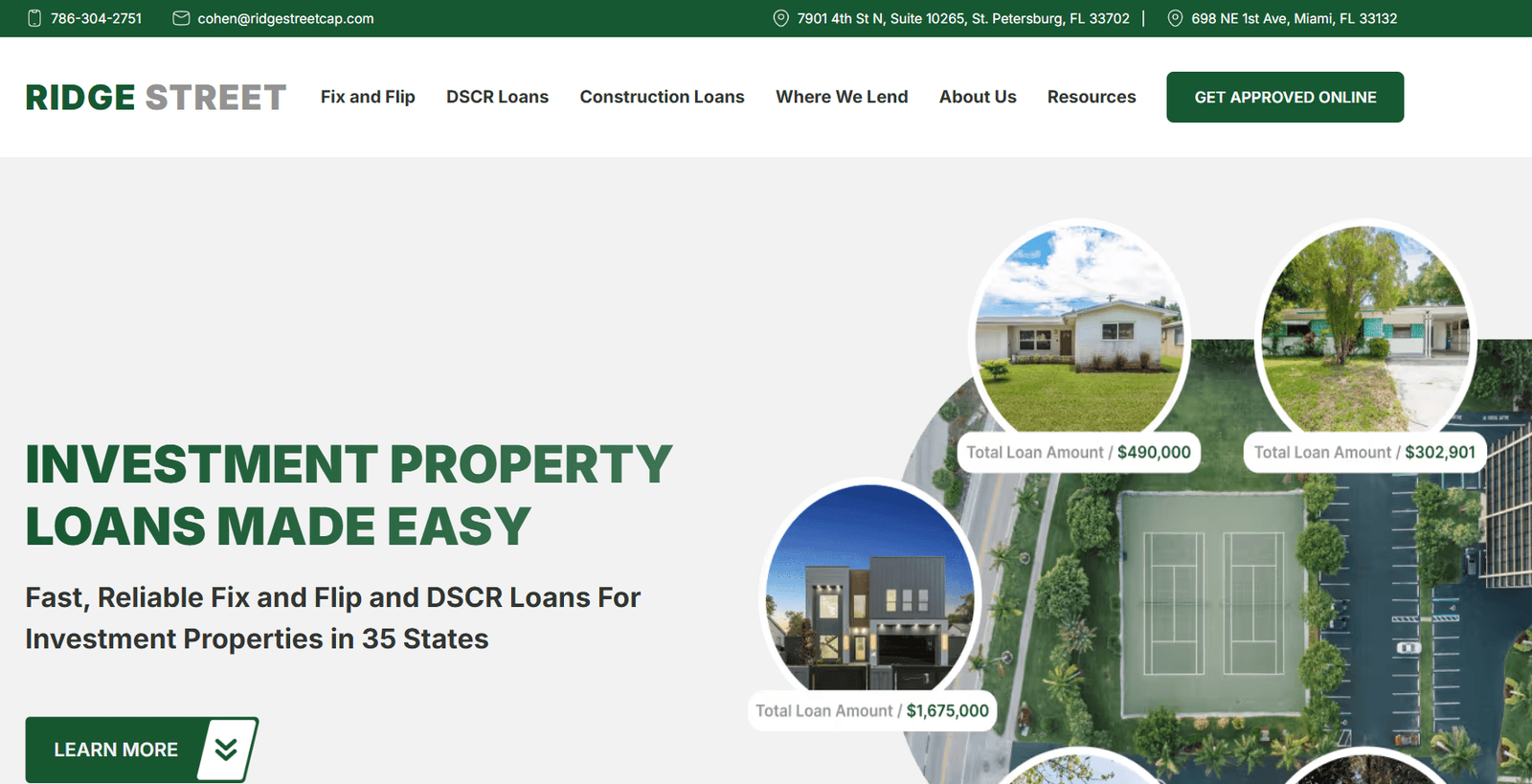
Ridge Street Capital is a private real estate lender built specifically for real estate investors who want speed, flexibility, and scalable financing without the bureaucracy of traditional banks.
Based in Brickell, Miami and lending in 36 states, Ridge Street focuses exclusively on investment property loans. Unlike generalist lenders, every program is designed around the needs of fix-and-flip operators, BRRRR investors, and rental portfolio builders.
What separates Ridge Street from most lenders is its investor-first structure: highly competitive DSCR rates (including a short-term rental DSCR program), beginner-friendly fix-and-flip terms, and industry low fee structures, including 0% origination options on DSCR loans.
The loan application process is streamlined and term sheets are typically issued within 2 business hours. Fix & Flip loans close in 7–10 days, while DSCR loans close in 21-25 days, consistently faster than most rental lenders.
Key Programs:
- DSCR Loans (Long-Term Rentals & Airbnb Loans) from $55K to $2M
- Fix & Flip Loans (Acquisition + Renovation) from $50K to $3M
- BRRRR Strategy Financing (Hard Money + Cash Out Refinance DSCR Loans)
Best For:
- BRRRR investors scaling rental portfolios
- Short-term rental (Airbnb) investors seeking competitive DSCR options
- First-time Fix & Flip investors who need guidance
- Investors prioritizing low fees and fast closings
Pros and Cons:
2. Lima One Capital
Overview:
Lima One Capital is a national private lender based in Greenville, South Carolina, with over $10 billion in funded real estate investor loans. Their product range covers Fix & Flip, DSCR rentals, portfolio loans, ground-up construction, and bridge financing. The in-house servicing model manages the full loan lifecycle from origination through draw funding, reducing third-party delays on renovation projects.
Lima One is particularly strong for investors managing growing portfolios, including those consolidating multiple properties into a single blanket loan or refinancing into a portfolio DSCR structure.
Key Programs: Fix & Flip, DSCR Rental, New Construction.
Qualification: 660 minimum FICO (Fix & Flip & DSCR). Fix & Flip Loans from $100K to $5M, Up to 95% LTC and 75% LTV. DSCR Loans from $85k to $2.5M, Up to 80% LTV.
Best For: Investors managing 5 or more properties, BRRRR operators who want portfolio refinance options in one place, and multifamily or new construction developers.
Pros and Cons:
3. Kiavi
Overview:
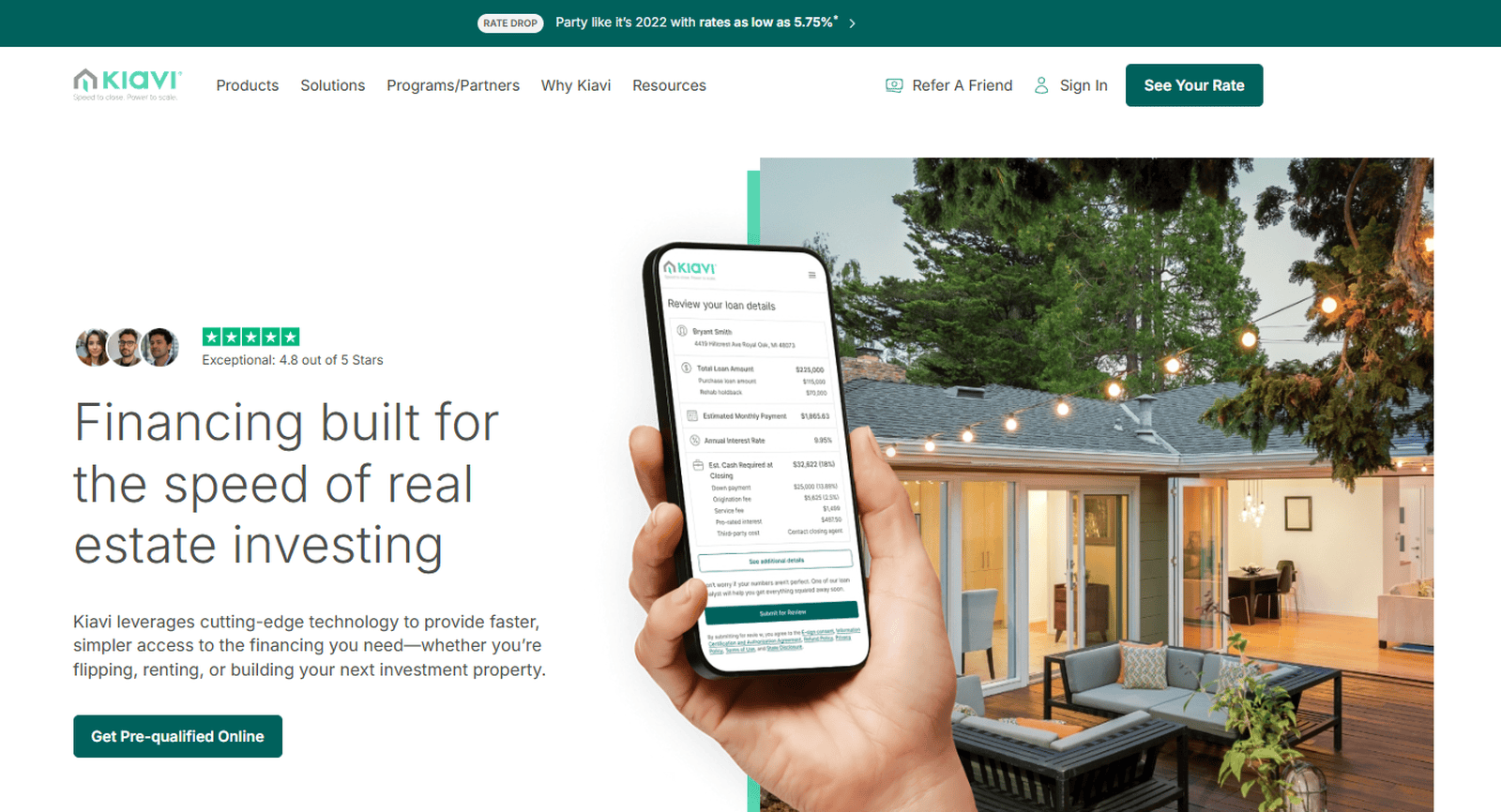
Kiavi is a nationwide private real estate lender that uses a tech-driven platform to finance investors flipping, renting, or building residential investment properties, including single-family rentals and small portfolios.
Their platform uses machine learning, automated underwriting, and real-time data pricing to close faster than most manually underwritten lenders. The fully digital process makes Kiavi especially well-suited for experienced investors running multiple deals simultaneously.
Key Programs: Fix & Flip, Bridge, Jumbo Loans, DSCR Rental, New Construction
Qualification: Fix & Flip loans from $100K to $5M, up to 95% LTC / 80% ARV and100% rehab. DSCR loans: Up to 80% LTV
Best For: Experienced, high-volume investors who prioritize speed and automation over relationship-based service, and tech-forward operators scaling across multiple markets simultaneously.
Pros and Cons:
4. Easy Street Capital
Overview:
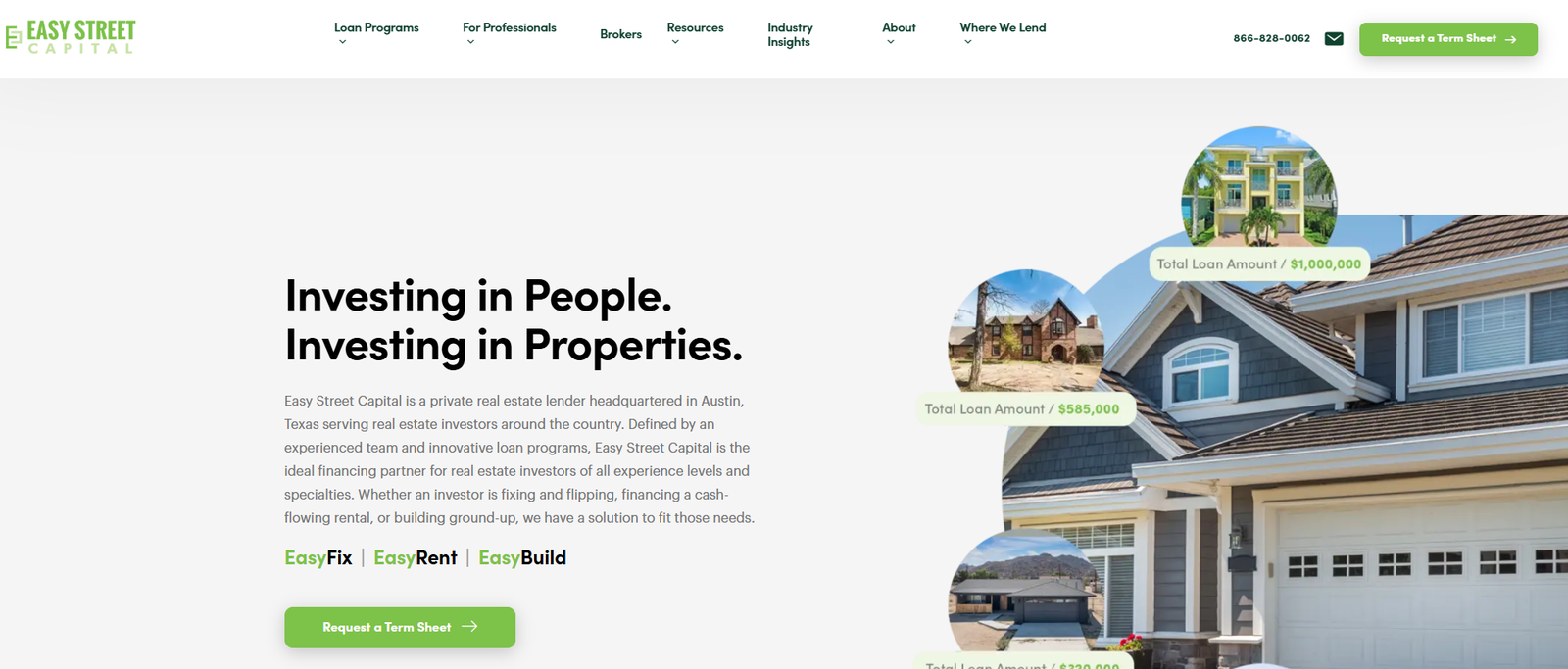
Easy Street Capital is a private lender based in Austin, Texas, built around transparency. Investors can generate their own term sheets online before speaking to a loan officer, which makes deal feasibility analysis faster and removes the usual back-and-forth from early-stage conversations.
Positioned as a flexible and competitive terms lender, Easy Street Capital offers solutions for anyone – from first-time investors dipping into industry veterans looking to rapidly expand their portfolios.
Key Programs: EasyFix (Fix & Flip), EasyRent (DSCR Rental), EasyBuild (New Construction)
Qualification: 600 minimum FICO (Fix & Flip), 640 (DSCR). Fix & Flip loans from $75K to $5M, 100% Rehab and 90% Purchase. DSCR loans from $100K to $3.5M, Up to 80% LTV.
Best For: Fix & Flip investors who need to close fast or have deals other lenders won't touch. DSCR investors with credit scores below 640.
Pros and Cons:
5. Griffin Funding
Overview:
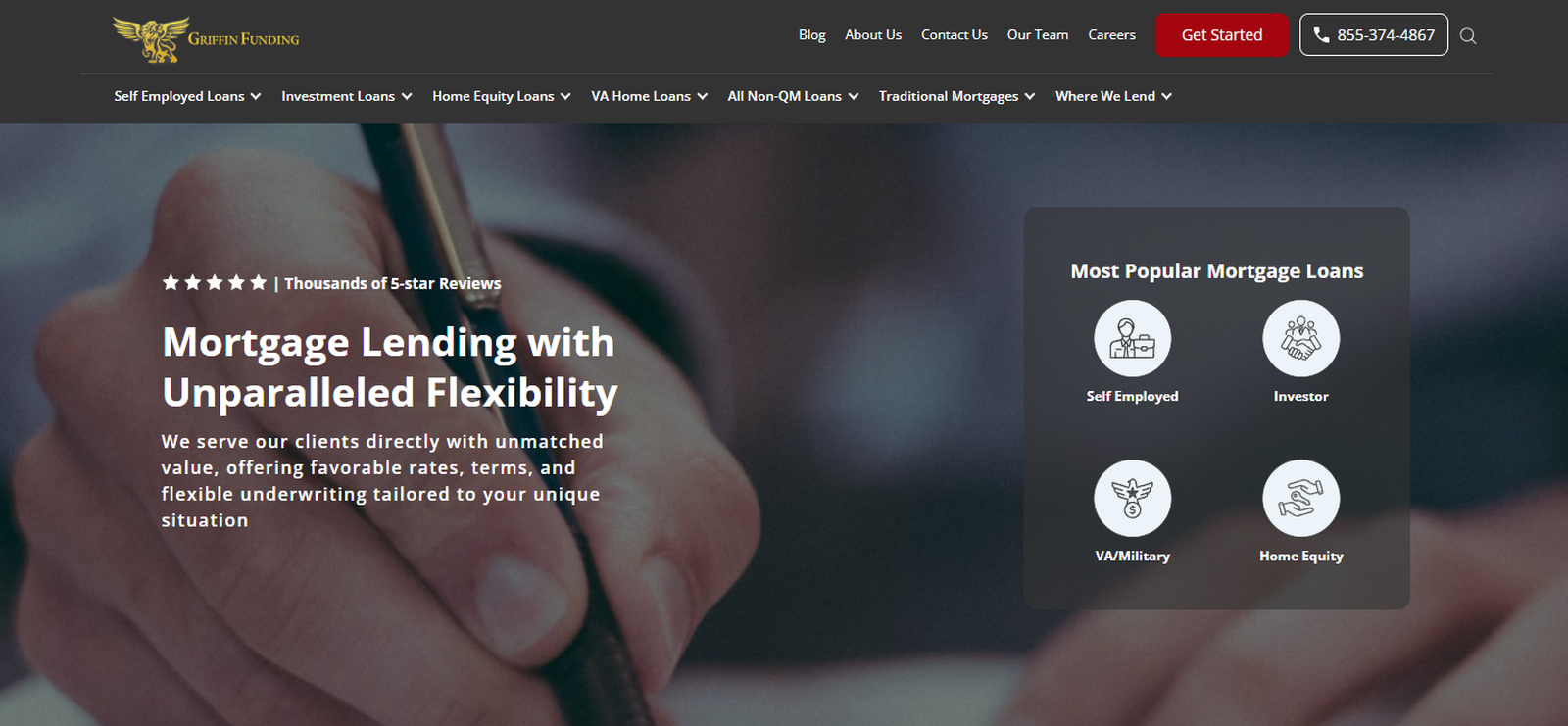
Griffin Funding is a direct-to-consumer non-QM lender operating in all 50 states with a product line built specifically for borrowers who don't fit conventional mortgage guidelines. Where most private lenders stop at DSCR, Griffin extends into the full range of non-QM financing: bank statement loans for self-employed investors, asset-based loans for high-net-worth borrowers, 1099 and P&L loans for contractors and business owners, and VA loans for veterans. That range makes Griffin the rare lender that can finance both the investment property and the borrower's conventional mortgage under one roof.
Key Programs: DSCR Rental, Fix & Flip, P&L Loans, Flex Jumbo Loans, Bank Statement, VA, Conventional, HELOC.
Qualification: 620 minimum FICO (580 for VA). DSCR: 20% down. Fix & Flip loans up to $5M, 100% Rehab and 90% Purchase. DSCR loans from $100K to $4.5M, LTV up to 85%.
Best For: Self-employed investors, veterans and personal mortgage products under one lender. Particularly strong for investors whose taxable income understates actual cash flow.
Pros and Cons:
How to Choose the Right Investment Property Lender
The right lender depends on your strategy, your deal timeline, and your loan type. The two most commonly used products in investment property financing, DSCR loans and hard money, serve fundamentally different purposes. DSCR loans are long-term, income-based, and designed for stabilized rentals (long-term rentals and short-term rentals). Hard money / Fix & Flip loans are short, deal-based, and designed for acquisitions and renovations. Many strategies, including BRRRR, use both in sequence.
The table below maps investor profiles to the right lender and loan type.
Before committing to any lender:
- Confirm the loan type matches your real estate investment strategy and property condition.
- Get the term sheet in writing and review origination fees, prepayment penalties, and reserve requirements alongside the rate.
- Ask specifically about closing timelines and what can delay them.
- Stress-test your DSCR at a rate 0.5%-1% higher than quoted. If rates move before you close, you need to know the deal still works.
Investors building in specific regions often benefit from regional specialists. For example, a Florida hard money lender may offer better terms for Miami deals than a national platform, while Texas DSCR loans come with state-specific nuances worth understanding.
Ready to Apply? 5 Steps to Qualify for an Investment Property Loan
Investment property loans use different qualification standards than primary residence mortgages. Most private and DSCR lenders focus on five things:
1. Know your credit score. Most investor-focused lenders set a minimum around 660, but your score also affects pricing. Pull your credit before choosing a lender so you know which programs you qualify for and whether a small score improvement could move you into a better rate tier.
2. Confirm your down payment source. Lenders need to know where your down payment is coming from and how long the funds have been in your account. Season and document the funds before underwriting. Last-minute transfers can delay the file or raise questions.
3. Match the loan to the property condition. DSCR loans are built for rent-ready, income-producing properties. If the property needs significant repairs, it usually needs a hard money or rehab loan first. Trying to force a distressed property into a DSCR program is a common application mistake.
4. Define the exit before closing. For fix-and-flip and bridge loans, the lender needs to know how the loan will be repaid: sale or refinance. If the deal is part of a BRRRR strategy, get pre-approved with a DSCR lender before closing the hard money loan. That step helps avoid the most common BRRRR failure point: finishing the rehab but being unable to refinance out.
5. Get the terms in writing. Before paying upfront fees or authorizing an appraisal, get the full term sheet in writing. Review the rate, points, leverage, reserves, prepayment penalty, draw process, and closing timeline.
If you are ready to run the numbers on your next deal, Ridge Street Capital issues term sheets within 2 business hours and provides pre-approval letters for investors with properties already lined up.
Frequently Asked Questions
How do investment property loans differ from residential mortgages?
Investment property loans are underwritten on different criteria than residential mortgages. Where a residential lender evaluates your personal income, employment history, and debt-to-income ratio, investment property lenders focus on the asset — the property's cash flow, after-repair value, or rental income potential. That shift in underwriting logic is what makes these loans accessible to self-employed investors, LLC borrowers, and portfolio builders. In most cases, the qualification process is faster, documentation requirements are easier, and the decision is driven by deal economics rather than personal financial history.
How much cash should you have in reserves for an investment property loan?
Most lenders require cash reserves equal to six months of mortgage payments for an investment property loan. These reserves help cover monthly mortgage payments, insurance, taxes, and other loan costs if rental income is interrupted
Can investment property loans have interest-only payments or flexible terms?
Yes. Investment property loans are generally more flexible in structure than residential mortgages. Fix and flip loans are typically interest-only for the full loan term, keeping monthly payments low during the renovation period.
Many DSCR loans also have interest-only options, usually for the first 5 to 10 years, before converting to a fully amortizing payment. Eligibility depends on factors such as property type, loan amount, credit score, and rental income. For investors, interest-only structures help preserve cash flow during stabilization or renovation periods.
Can an investor use more than one lender at the same time for different properties?
Yes, and many active investors do. There is no rule requiring an investor to consolidate all financing under a single lender. A common approach is using one lender for hard money acquisitions and a different lender for DSCR refinances, or splitting a portfolio across multiple lenders to diversify against any single lender tightening guidelines or pausing originations.
The tradeoff is administrative: managing separate applications, underwriting timelines, and relationship contacts across multiple lenders takes more coordination than working with one lender who can handle the full range of loan types a strategy requires.

Zach Cohen is the Managing Partner of Ridge Street Capital, a direct private lender providing hard money and DSCR loans to real estate investors across 36 states. Under his leadership, the firm has funded nearly $100 million in investment property loans. He regularly works with real estate investors on rental property acquisitions, refinances, and fix-and-flip projects across the country.
Fix and Flip Loans
Funding For Purchase + Rehab
- $50,000 up to $3,000,000
- Interest Rate 10.5%-11.5%
- Origination Fee From 1.5%
- Up to 90% of Purchase and 100% of Rehab

DSCR Loans For Long Term Rentals
Perfect for first-time investors or experienced investors scaling their rental portfolio.
- Up to $2,000,000
- Interest Rates from 6.0%
- Origination Fee From 0%
- Up to 80% of LTV

DSCR Loans For Short Term Rentals
Designed for investors pursuing higher rents with a short term rental strategy.
- Up to $2,000,000
- Interest Rates from 6.25%
- Origination Fee From 0%
- Up to 80% LTV
Ready to Get Started?
.svg)